
Optimizing the B2B Software Buying Process for Startups

Discover how startups can streamline their B2B software buying process, reduce costs, and make smarter SaaS decisions with a structured, ROI-driven approach.
Explore key steps to streamline your B2B buying process and avoid costly software mistakes
In the current startup ecosystem, where every dollar counts and the speed of execution is often the difference between success and failure, the process of purchasing SaaS represents a strategic challenge of significant importance. According to Gartner, 77% of B2B buyers think that the purchase process is complex and time-consuming, requiring on average 6 to 10 decision-makers who, together, spend 45% of their time looking for and evaluating solutions.
For startups in seed or scale-up stage, this complexity is worsened by the critical sizing of the budget: every subscription must deliver a return on investment (ROI), integrate into the existing technical stacks, and support growth without becoming an operational bottleneck. Founders often underestimate how much time these decisions absorb, especially when each tool must align with fast-changing business priorities and limited internal resources. A structured approach to SaaS buying not only helps control spending but also prevents the costly mistakes that come from choosing tools that don’t scale or integrate well.
This guide presents a practical framework to improve every phase of SaaS acquisition, from the identifying needs to negotiating prices, to direct you to the right solution at the right time.
Understanding the B2B SaaS Buying Process
SaaS-Specific Considerations for Startups
Unlike purchasing physical products or making spontaneous B2C transactions, acquiring subscription-based software involves its own structural complexities:
- Recurring financial commitment: A SaaS department of €200/month represents a long-term investment of €2400/year, multiplied over several years. This projection requires careful assessment of the vendor's sustainability, product evolution and long-term support capabilities.
- Technological lock-in: Switching from one CRM, accounting solution or billing tool to another generates considerable internal costs (data export/imports, reconfiguration of workflows, team training). Choosing the wrong tool early on can lead to weeks of lost productivity.
- Multiple trade-offs: Unlike B2C purchases, which often depend on individual preferences, B2B SaaS decisions typically involve several stakeholders with distinct priorities. The CTO will analyze the technological architecture and the quality of the APIs, the CFO will analyze the TCO (Total Cost of Ownership) and the financial flexibility of the contracts, while end users focus on usability and learning curve.
For startups, understanding these complexities is crucial before committing to any new software. Each decision carries long-term implications for budget, efficiency, and scalability. Taking time to evaluate not just the product but the relationship with the vendor, integration effort, and the adaptability of the tool can make the difference between a system that empowers growth and one that quietly drains resources.
Stakeholders Involved in a Startup
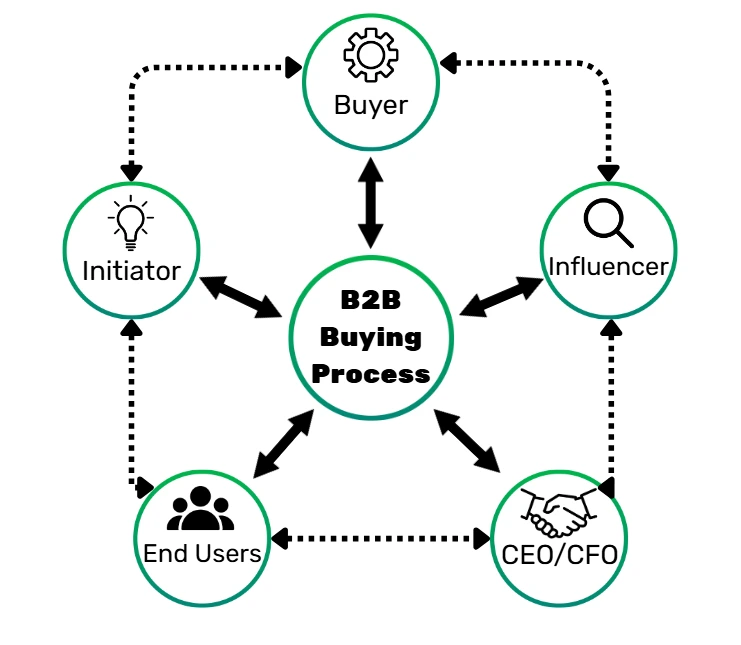
In the lean structures typical of startups, classic B2B buying process roles are often handled by just a few versatile team members:
- The initiator identifies the operational pain point (e.g., "Our manual invoicing process wastes 10 hours per week")
- Influencers bring their technical or business expertise to narrow down the shortlist
- The final decision-maker (often CEO or CFO) ensures the choice aligns with the company’s strategic goals and budget
- The buyer handles negotiations and manages the ongoing subscription
- End users determine whether the tool actually fits into their daily workflow
In teams of just 5-15 people, it’s common for one person to wear 2-3 of these hats, potentially accelerating the decision-making but also increasing the risk of overlooking key evaluation criteria.
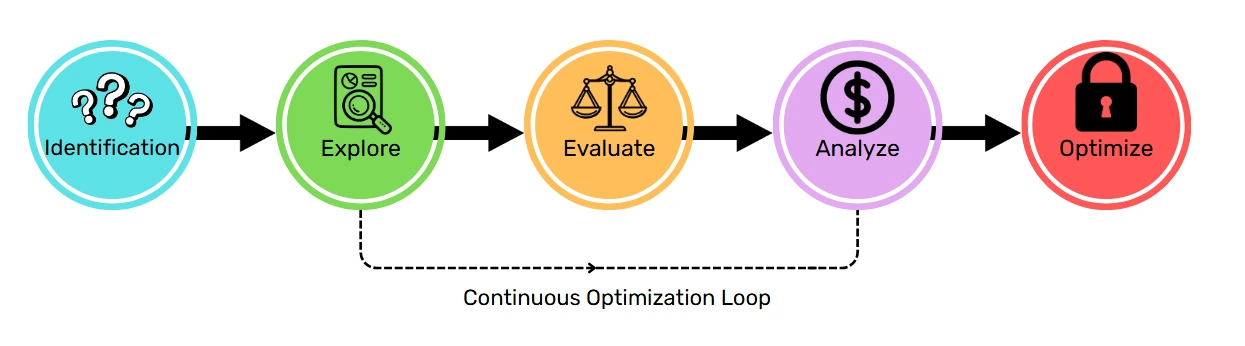
The 6 Stages of the Optimized Buying Process
Stage 1: Need Identification
Every acquisition cycle begins with the recognition of a business issue that needs solving, or an improvement opportunity that must be seized. This exploratory phase requires the precise mapping of pain points: Is productivity being lost due to a recurring bottleneck that slows growth? Is there user experience friction that reduces efficiency? Is there a growing risk of non-compliance with regulations?
Need Qualification Methodology:
- Quantifying current impact: How many man hours per week does the issue cost the team? What is the financial loss suffered?
- Defining the success criteria: What KPIs will measure how effectively the chosen solution performs?
- Identify key personas: Which teams will use the tool most frequently?
Concrete Use Cases:
For a hypergrowth startup, it’s possible to centralize its project management, technical documentation and knowledge management in a unified tool like Notion, instead of having to deal with several disparate management tools. Our complete Notion review explains in detail which team profiles (creative, technical, ops) get the best ROI from this solution and for which usage contexts this becomes limited.

A similar logic is valid for a young company whose complexity of accounting exceeds the possibilities of being managed on Excel. Here, the new company must choose between online and offline solutions in order to find the package which will create the greatest efficiency. Our detailed analysis of Xero outlines when this platform outperforms alternatives, such as multi-currency management, automated bank feeds, or seamless collaboration between accountants and founders, and when another option might be a better fit.

Stage 2: Solution Exploration
Once you are committed to the need, the discovery phase will be to map out the entire competitive landscape. This is like strategic intelligence: which players are dominant in the segment? Which competitors propose disruptive approaches? Which solutions are on the rise?
Information Sources to Leverage:
- Joinsecret, Product Hunt and G2 Crowd to identify high-growth solutions
- Reddit and Indie Hackers for unfiltered founder experience feedback
- Stack Overflow and GitHub to evaluate technical community vitality
- Specialized comparators aggregating features and positioning
The Importance of Broad Benchmarking:
McKinsey finds that 85% of the decision-makers using the generative AI for competitive intelligent reporting are “very satisfied” by their analysis’ efficiency and completeness. The democratization of discovery tools decreases the information asymmetry that exists between the buyer and the seller
Examples:
Imagine you are creating a fintech and looking for a stable play. Check out these Stripe alternatives: Adyen (great for international multi-currency and settlement), Mollie (best for the European market), and Lemon Squeezy (great if your products are digital). Each of these has specific weaknesses of pricing, service geography, and degree of difficulty of integration.

For those requiring secure and scalable authentication, our guide on Auth0 competitors offers a comparison tailored to your budget, compliance and control of tech stack limitations between managed products (Clerk, WorkOS) and open source products (Keycloak, Ory).

Stage 3: Building Evaluation Criteria
This structuring phase converts the long list of possible platforms into a shortlist of 2-3 finalists. It requires formalizing your requirements in a weighted evaluation grid.
Technical Criteria to Document:
- Performance and latency: acceptable response times, guaranteed SLAs
- Scalability: API call limits, storage, concurrent users
- Architecture: multi-tenancy, data residency, deployment options (cloud/on-premise/hybrid)
- Security: certifications (SOC2, ISO 27001), vulnerability management
Functional Criteria to Prioritize:
- Feature completeness: coverage of critical use cases today
- Roadmap alignment: announced future capabilities matching your 12-18 month vision
- Customization: extensibility via API, webhooks, custom fields
Economic Criteria to Model:
- Pricing structure: per-seat, usage-based, flat-rate, freemium
- Projected TCO: cost at 1 year, 3 years, including third-party costs (integrations, training, support)
- Contractual flexibility: downgrade possibility, annual vs monthly billing
Building clear evaluation criteria helps transform a complex buying decision into a transparent and measurable process. By defining what truly matters (technical reliability, functionality, scalability, and long-term cost) you can ensure that each shortlisted option is assessed on objective grounds rather than assumptions or internal preferences.
Examples of Head-to-Head Comparisons:
Are you wrestling between two top-rated accounting software? Our Xero vs Quickbooks details the plusses feature by feature: Xero proves its prowess in modern UX as well as FinTech integration while Quickbooks proves its domain competence in functional detail not found in Xero for Accounting firms, as well as US Tax compliance.

For Omnichannel customer support, our Zendesk vs ServiceNow focuses on the two opposing products philosophy: Zendesk focuses on simplicity to adopt an agent experience, whereas ServiceNow focuses on the enterprise clients with complex orchestrations to meet ITSM needs. Your choice comes down to size of your team and process maturity.
Stage 4: Vendor Evaluation and Pricing Analysis
More than mere characteristics, detailed analysis of pricing strategy is often the determining element in the final proposed resolution. Pricing models for SaaS products have changed considerably: there are no longer simple pricing charts, but tiered systems which can have large ineffective implementation costs.
Anatomy of Hidden Costs:
- Onboarding and setup fees: some vendors charge for initial implementation, data migration, or access to premium support resources
- Integration costs: APIs with restrictive call limits, paid webhooks, third-party connectors via marketplace at additional rates
- Aggressive feature gating: essential functionalities reserved for higher tiers, forcing early upgrade
- Overage charges: quota overruns (storage, emails sent, compute minutes) billed at premium rates
The Per-Seat Pricing Trap:
For a fast-growing start-up, linear pricing per user can cause unexpected explosions in budget. If the team has grown from 8 to 25 persons in the 6 months, then a SaaS at $30 user/month has a bill of $240 which rises to $750 monthly, or $9,000 per year.
Practical Pricing Decryption Cases:
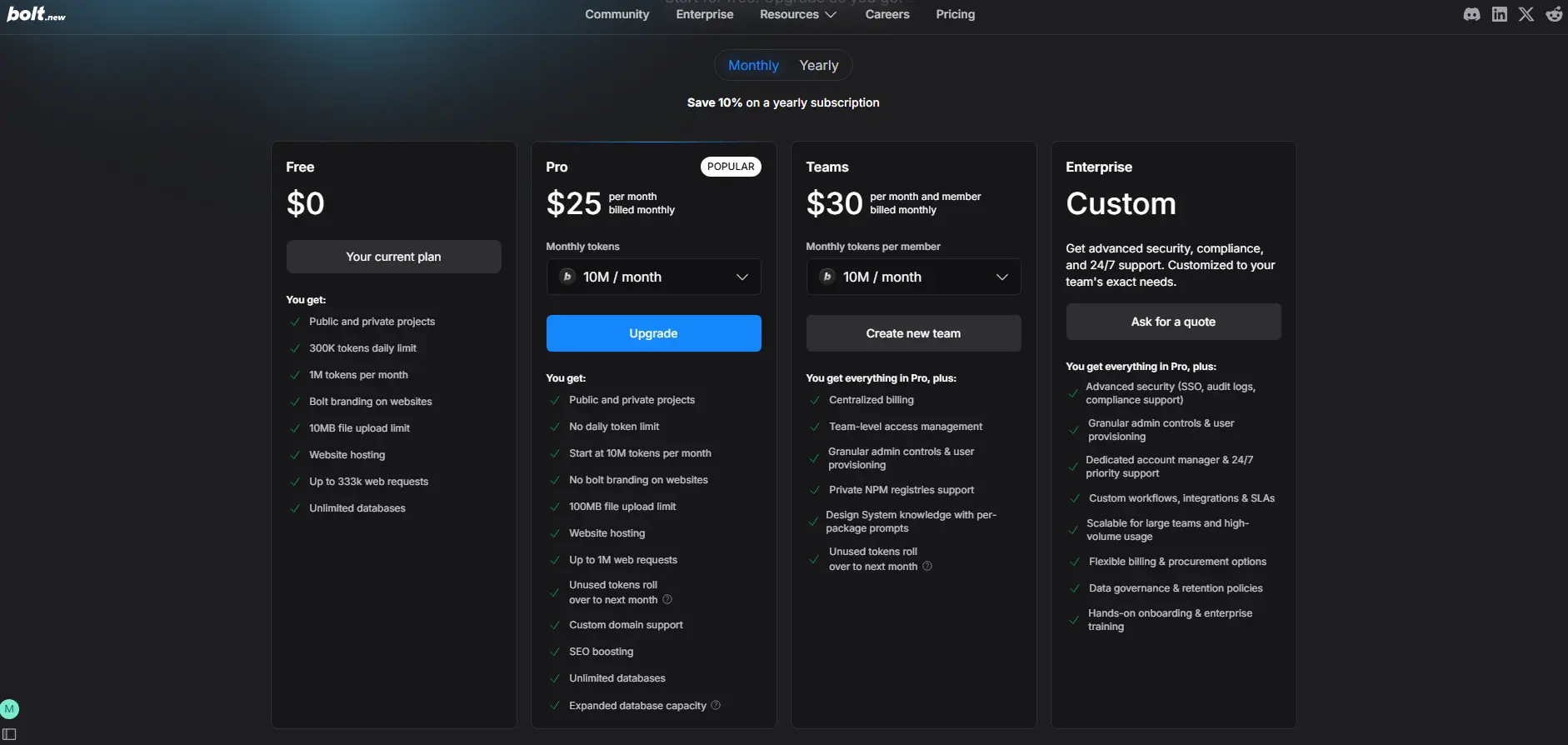
Take Bolt.new’s pricing as an example: this emerging cloud IDE offers a freemium plan with computing credits that can be quickly consumed during more intensive tasks. Our research shows where the free tier’s limits begin, when paid features become essential, and how to adjust workflows to maximize productivity within the free allowance.
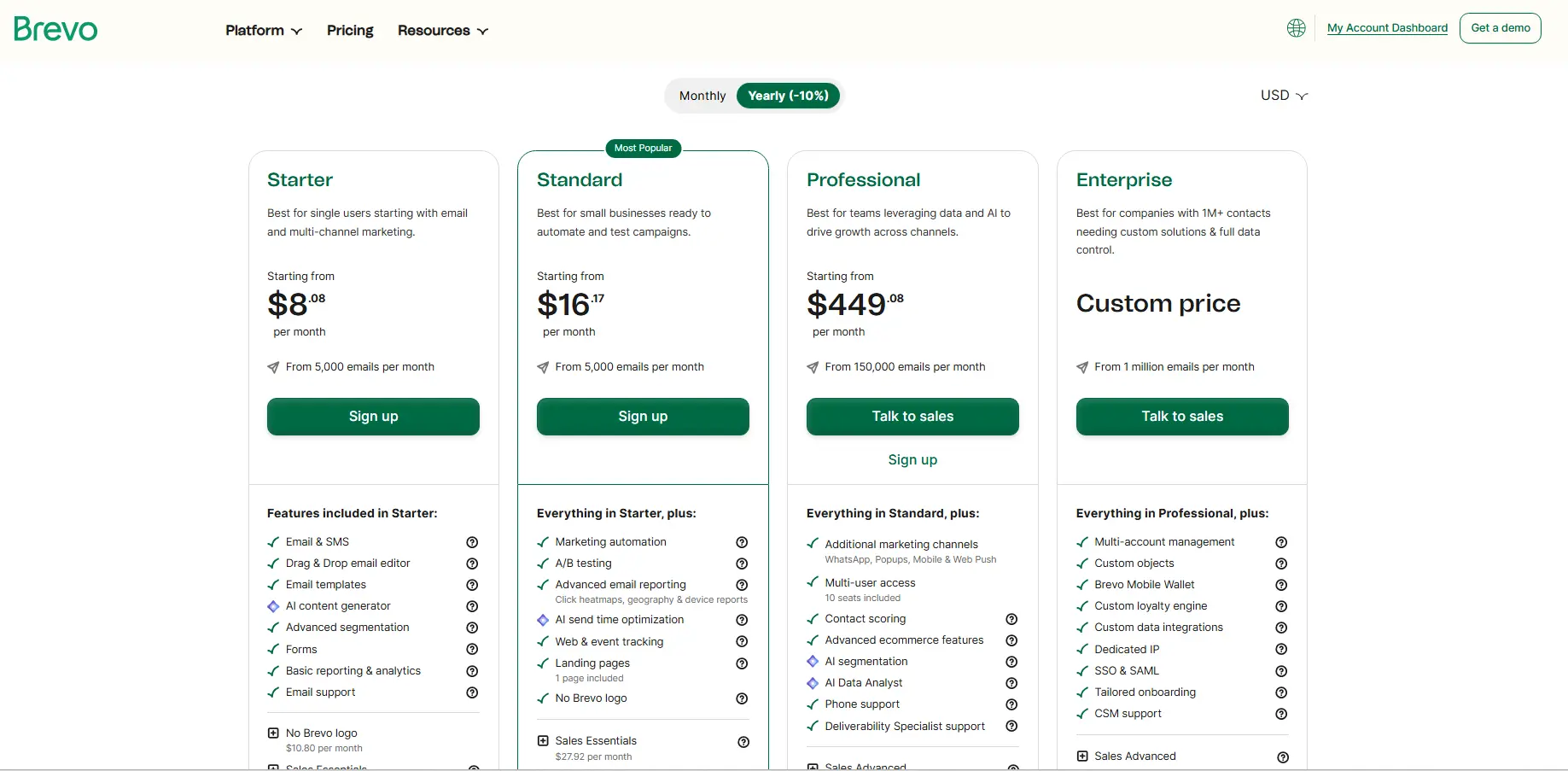
Similarly, pricing and plans from Brevo take a different approach: its hybrid pricing (unlimited contacts, charging for e-mail range sent) can be a real advantage for newsletters with a large subscriber base and low sending frequency. Compared to older models that charge per contact, this structure offers more flexibility and better cost control for growing startups.
Stage 5: SaaS Cost Optimization, The Key to Budget Control
For startups with limited runway, every percentage saved on their SaaS stack can translate into a few extra weeks of operating freedom. This stage of active cost optimization often distinguishes teams that manage their resources strategically from those who gradually lose control of their budgets without realizing it.
Immediate Cost Reduction Strategies:
1. Promotional Codes and Launch Offers
There are vast commercial incentives offered by SaaS providers to expedite acquisition: discounts of 20-50% on first year prices, free credit, bonus months in return for annual commitment. Such incentives are not to be found on official websites but are commonly available through partner/distributor outlets, affiliate schemes, or community deals.
You can start saving immediately with our exclusive Xero promo code for up to 90% off the first 6 months of your subscription, being ideal for bootstrapping your accounting framework without impairing your launch treasury.
Reduce your social media management costs down with our Hootsuite promo code offering 3 months free on the Standard plan, enabling you to trial the tool throughout a full campaign cycle before commitment.
{{cta-marketplace="/blog-elements"}}
2. Strategic Purchase Timing
SaaS vendors experience cyclical commercial pressure peaks:
- End of quarter/fiscal year: revenue targets to hit, maximum flexibility on discounts
- Black Friday/Cyber Monday: exceptional promotions (up to 50% off)
- New version launches: incentives to quickly migrate to v2/v3
3. Aggressive Contract Negotiation
Never accept the first price you see. SaaS sales reps have significant room to maneuver, particularly for multi-year contracts or significant volumes. Negotiation levers:
- Duration commitment: annual vs monthly can unlock 20-30% discount
- Prepayment: upfront payment versus installments
- Case study/testimonial: marketing visibility in exchange for preferential rate
- Bundling: grouping multiple vendor products for optimized global pricing
4. Stack Consolidation and Duplicate Elimination
An average startup relies on 20 to 40 different SaaS. This abundance often leads to costly overlaps: two video conferencing tools, three project management solutions, four email marketing platforms. A quarterly stack audit systematically reveals 15-25% potential savings via:
- Identifying ghost licenses (ex-collaborators still billed)
- Detecting duplicated functionalities between tools
- Taking advantage of integrated suites (e.g., Google Workspace vs dispersed Slack + Zoom + Drive)
For startups, these practices go beyond simple cost-cutting; they build financial discipline and ensure that every subscription genuinely supports growth. Regularly revisiting your contracts and stack composition keeps your tools aligned with your evolving needs instead of letting unused or overpriced software quietly drain resources.
5. Free Trials and Startup Credits
71% of B2B buyers consider trial access as significantly influencing their decision. Maximize value extraction from trial periods:
- Intelligently sequence tests: don't activate 5 trials simultaneously but stagger them to benefit from active vendor support on each
- Exploit startup programs: AWS Activate credits, Google cloud credits, Microsoft for startups offer tens of thousands of dollars in credits
- Convert POCs to production: negotiate transforming the test environment into production rather than reconfiguring everything

JoinSecret's Role in Budget Optimization
JoinSecret aggregates all these optimization levers by centralizing verified promotional codes, exclusive deals negotiated in volume. Our platform saves an average of 20-35% on your annual saas stack i.e. a saving of several thousands of dollars reinvestable in product growth or customer acquisition.
Stage 6: Validation, Purchase, and POC
The final validation phase mobilizes internal consensus mechanisms and field confirmation. Even in a small team, this step formalizes alignment and prevents post-purchase disappointment.
Effective Validation Protocol:
1. Interactive Demos and Sandbox
TrustRadius reports that 100% of B2B buyers express a preference for self-service options. Sales rep-guided demos generate frustration (imposed pace, focus on vanity features) while autonomous test environments allow evaluating real workflows on representative data.
Systematically require:
- Full sandbox access with pre-loaded test data
- Exhaustive technical documentation (API reference, data model)
- Dedicated support during evaluation period
2. POC on Critical Use Case
Select a business process representative of medium complexity and implement it end-to-end in the test environment. Quantitatively measure:
- Implementation time vs vendor promises
- Spontaneous adoption rate by end users
- Bugs/blockers encountered and support responsiveness
3. Customer Reference Validation
86% of enterprise buyers start their search with already-known brands and 71% choose their first choice from that shortlist. Trust is built via:
- Detailed case studies: business metrics before/after, quantified ROI
- Authentic reviews: with the fake review phenomenon (73% of buyers regularly detect them), prioritize reviews from peers in your industry and company size
- Peer conversations: ask the vendor for 2-3 customer contacts accepting a reference call
4. Decision Consensus
Formalize a shared decision matrix with stakeholders:
- Weighted criteria scoring (functional 40%, cost 30%, risk 15%, UX 15%)
- Collective POC review session
- Documentation of objections and vigilance points
- Secret ballot vote if necessary to avoid seniority bias
When startups take time to validate before buying, they reduce the risk of expensive misalignment later and strengthen internal trust in the decision-making process. In the end, a well-tested, well-chosen tool becomes more than a line item, it becomes a foundation for scale.
The 10 Key Evaluation Criteria for Startups
Beyond the sequential process, certain transversal criteria deserve particular attention in the startup context:
1. Performance and Operational Reliability
A SaaS product that is frequently subject to downtime or considerable latency is immediately a productivity felony. See the SLAs (Service Level Agreement) in the contracts: a guaranteed uptime of 99.9% means 8h43 of possible downtime per year, while 99.95% limits this to 4h22. Worthy suppliers publish their exploration results on public status pages accessible to all.
2. Optimized Pricing and TCO
A full cost, beyond the face value, which integrates the fees for the implementation, the fees for the training on the tool, the surcharge for integrations, and the opportunity cost of its limitations. A tool which is free (but time-consuming) may be demonstrably more expensive than a commercial one whose efficiency exceeds it.
3. Scalability Without Cliff Effects
The stack must follow you in your growth without there being brutal migrations. The question: beyond which threshold (of users, of volumes, of transactions) of the current plan it constitutes a bottleneck? Is the transition to the upper tier progressive or does it require refactoring?
4. Integrations and Interoperability
An isolated SaaS product is a data silo. It is when it is part of the assemblage with the existing stack (CRM, accountancy, marketing automation, support), that its value is realized. Examine the eco-system of the native integration (number, richness), the quality of the APIs (REST/GraphQL? webhooks? thresholds?), whether the connectors of the tool in question are present via Zapier/Make.
5. Learning Curve and Time-to-Value
A too-overpowered but impenetrable tool creates resistance to changing working methods. So to speak, the progressive onboarding, the pedagogical documentation, the readily usable templates ensure that the tool is operationally adopted. Measure the time before the production of the first value (in hours, days or weeks)?
6. Support Quality and Responsiveness
The layers of a SaaS support [sic] are the following: by mail (and ticket) only (free/low cost), chat with SLA on reaction times of 4 to 24 hours (mid-market), dedicated success manager + hot-line (enterprise). For a startup, the supportive emails (< 8h) on the legally serious blocks forms the minimum vital severelife.
7. Security, Compliance, and Data Sovereignty
GDPR in Europe, CCPA in California, SOC2 for B2B enterprise clients: compliance is non-negotiable. Verify also where the data is localized (EU host or US), how it is encrypted (in transit, or at rest), whether the security audits are public.
8. Guaranteed Uptime and Resilient Infrastructure
The architectures of the MT-AZs, the (multi-availability zone) automated backup strategy, the well-documented recovering structure distinct questions the good vendors from the data-fragile solutions. Reliability is for 40% of the buyers the basic barrier to purchase.
9. Contractual Flexibility
For a constantly-pivoting and evolutionary startup the conditions and limits of the contract become toxic. Prioritize: monthly or quarterly commitment rather than a crystalline annual one, the capacity to downgrade provided that no penalty involves, simplified clauses of termination..
10. Community and Ecosystem
A SaaS having an active community (forums, Slack/Discord, meetups) reduces dependency on the official support, A rich presence on the marketplace (extensibility, plugins, certified consultants, templates) multiplies the possibilities for regenerative extensions of integration.
Taken together, these criteria form the backbone of a thoughtful SaaS evaluation process. They help startups move beyond surface-level comparisons and focus on what truly drives long-term value; reliability, scalability, flexibility, and community support.
How to Accelerate the Buying Process
The average B2B SaaS decision cycle extends 3-9 months for critical tools. For startups operating on 6-week product cycles, this inertia is unacceptable.
Proven Acceleration Levers:
1. Prioritize Product-Led Growth Vendors
Companies that take a freemium or trial-based approach to providing access without commercial objection (Notion, Airtable, Figma) will reduce the buyers' time-to-value from weeks into hours. 90% of buyers will expect a DTC feel in B2B.
2. Consume Short and Actionable Content
67% of B2B buyers prefer short-form subject matter versus 40 page white papers. Prioritize among: 3-5 minute videos, interactive comparators, ROI calculators, infographics versus 60 minute webinars.
3. Demand Pricing Transparency
38% of B2B marketing budgets go to brand-building, 53% to demand-gen budgets, but 66% of buyers choose the "most trusted option". Public pricing presentation (other than "contact sales") will greatly reduce friction in this area.
4. Exploit AI for Discovery Phase
Tools like ChatGPT, Perplexity and Claude enable the buyer to have dozens of comparative shortlists, personalized evaluation grids and compiled reviews instantly. McKinsey estimates that generative AI will yield a productivity increment of $800M-$1.2B in respect of sales/marketing functions.
5. Standardize Evaluations
Make a reusable vendor evaluation template (scoring grid, tech questionnaire, proprietary references) that turns each new evaluation into a semi-automated process rather than a production from scratch process.
Accelerating the SaaS buying process isn’t about rushing decisions; it’s about removing unnecessary friction. By focusing on transparency, accessible product experiences, and standardized evaluation methods, startups can move faster without sacrificing due diligence.
Conclusion: From Tactical Purchase to Strategic Optimization
The process of acquiring SaaS no longer consists solely of examining competitive suppliers in terms of the specific functional benefits of their products. It has become an element of strategic importance in the maximisation of the operational efficiency of start-ups. Each relevant supplier company and tool chosen and properly negotiated enhances the reallocation of resources to core business.
The methodology suggested - scrupulous analysis of need, exhaustive study of alternatives, structured multi-criteria evaluation, unrelenting cost breakdown management, overall cost savings, validation in the market - turns this often chaotic process into a robust and replicable template. When implemented consistently, it also builds a culture of financial discipline and informed decision-making that strengthens a startup’s long-term resilience. Over time, teams become more confident in their evaluations, negotiate from a position of knowledge, and rely less on trial and error.
Budget savings from promo codes, tactical purchase timing and hard nosed negotiating can yield savings of between 20-35% annually. On a SaaS stack of $2000/month, this means between $5000-8000 extra runway per annum.
Examine your current SaaS stack, consider the opportunities for optimising this and examine our exclusive promo codes to make immediate savings on operational expenses. Every dollar saved is another dollar available for reinvestment in your growth.
{{cta-marketplace="/blog-elements"}}